Black History Is Teamster History
The election of Barack Obama as President of the United States marks the beginning of a new and exciting chapter in the history of black Americans and strengthens the hope that one day all Americans really will be judged by the content of their characters.
Celebrating Black History Month this year is truly special, not just for Obama’s victory, but for all the hardships, sacrifices, risks taken and victories won by countless others along the way who forged the path that made his victory possible. It is also a poignant celebration as many who fought so hard for equality and justice did not, like Dr. King, make it to the Promised Land. Memories fade and we forget that everyday rights and privileges, now shrugged off as small or commonplace, once required great struggle and were hailed as great victories when achieved.
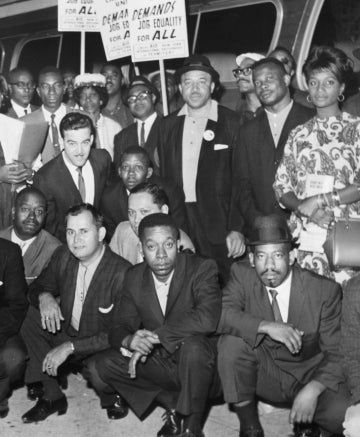
The Teamsters Union salutes all those who have played a role, large or small in creating the unique and powerful history of Black Americans. As part of Black History Month we also celebrate our own members and the great contributions they have made to the Teamsters. Black members are an integral part of the legacy we have created for working families over the last century. Whether serving as the first black milkman, a soldier defending freedom, a Rosie the Riveter on the home front in World War II, or traveling to Washington D.C to march with Dr. King or serve in a political action delegation, the experiences and achievements of our black members have made a difference and deserve to be recognized.
The contributions of black members to the success of the Teamsters Union are numerous, varied and as old as the union itself. Black team drivers attended the first Convention in 1903 and were active in all aspects of the union—including leadership, from the beginning. That commitment remains strong today.
Ferline Buie, International Trustee and member of the Teamsters General Executive Board recalled her experiences in a 2006 interview with Teamster magazine:
“When I joined Local 922 in Washington, D.C in 1966, I didn’t expect to be a member for very long. I didn’t know much about the Teamsters, but as a young black woman, I did not think there was much in it for me,” she said. “After attending a few meetings, I was pleased to discover there was much more to the union than I thought. In fact, I began to think maybe I could be a local union officer.”
And that aspiration started her on a path she never imagined possible.
“I went to the president of the local at the time, a white man named Ed Monahan, and told him my ambition. To my surprise, he took me seriously,” Buie said. “He said my race and gender didn’t matter if I was consistent, loyal and as involved as possible in the union. It changed my life.”
Today, in addition to her GEB responsibilities, Buie is also the President of both Local 922 and Joint Council 55.
Traditions To Build On
The Teamsters Union has traditionally been ahead of other unions in terms of the treatment of minority members, calling for ”no color line” in the union as early as 1906. The union and began actively seeking to organize black men and women at the same time. Black members made up half of the executive board at the first New Orleans local in 1903 and black women helped establish one of the first “color free” contracts in the country in 1917 as Teamsters negotiated equal pay for black and white laundry women. That foundation of equality led black members to become strong advocates for civil rights and other social justice causes through the years.
General President James R. Hoffa was strongly opposed to segregation of any kind and chose to forfeit prospective members rather than abandon the principles of the union. At one point in the 1950s, he and Vice President Harold Gibbons traveled to New Orleans to lead an organizing campaign at a chemical plant but were stonewalled by white workers demanding a separate local for black workers. Hoffa refused, knowing they would lose the election because of the decision. Hoffa was angry about the loss but felt the union was better off without such racist members. “We don’t need ‘em,” he said. “Their way is not the Teamster way.”
Joe Nero, who became a member of Local 272 in New York City in 1941, remained a proud Teamster until his death in 2004 at the age of 103. He always maintained that unions were the best thing to happen to black workers.
“The Teamsters did me right and gave me a good life. They didn’t care if I was black or white,” he said. “Being in the union was the difference between a good life and a tough one. Always was, always will be.”
This does not mean it has been an easy road for minorities in the union. Black members made up a smaller segment of the union and often faced many of the same prejudices from individual fellow members on the job as they did in society at large. But they had the courage to stand fast and demand respect and dignity for themselves and their families. We are all richer for it.
Information, interviews and articles from the past related to Black History Month will be posted during February.